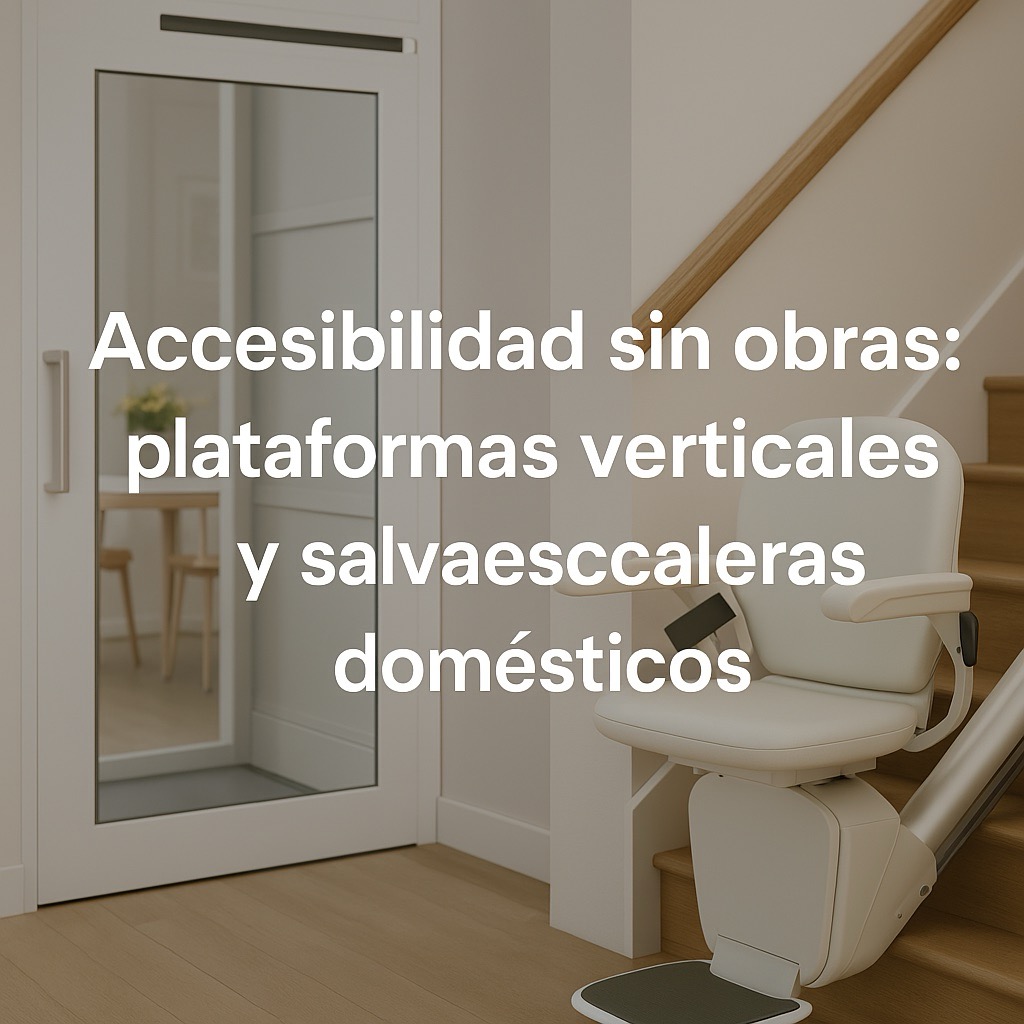
Accesibilidad sin obras con plataformas y salvaescaleras domésticos
21 octubre 2025


Hydraulic elevators have proven to be a versatile and efficient solution for facilitating mobility in single-family homes as well as in commercial and industrial buildings.
Their robust design, combined with their ability to operate in specific conditions, makes them a popular choice in a variety of installations. However, do you know what are the types of hydraulic elevators that currently exist and how they differ that exist and how they differ from each other?
Currently, elevators are classified in different ways, being the type of drive one of the most relevant factors. Within this classification, hydraulic elevators stand out for their fluid pumping mechanism to generate motion, differentiating them notably from electric and pneumatic ones. In this article, we will explore the characteristics, advantages and applications of the main types of hydraulic elevators available in the market.
From mechanical workshops to single-family homes, hydraulic elevators can be adapted to the specific needs of each environment. In addition, their operation, based on the use of a hydraulic pump and an electric motor, allows them to be highly efficient in spaces where the installation of an electric elevator would not be feasible. Want to know more? Join us to discover everything you need to know about hydraulic elevators and how to choose the right model for your needs.
h2>Types of hydraulic elevators
Hydraulic elevators have a wide variety of applications, from machine shops to private residences. Although they are most commonly used in the automotive industry to lift vehicles and facilitate their maintenance, they also play a crucial role in the vertical transportation of people and objects in buildings and homes. Below, we explore the main types of hydraulic elevators, their features, advantages and applications.
Single column hydraulic elevators are compact and designed for small spaces. For this reason, they are ideal for small machine shops where space optimization is needed. This type of lift is commonly known as a "hydraulic jack" in the automotive field. It works by means of a single piston that generates enough force to lift small to medium-sized vehicles, facilitating repairs and maintenance.
Although its load capacity is limited compared to other types, its simple and economical design makes it a practical option for workshops with limited space. In addition, it is relatively easy to install and maintain, which reduces long-term costs.
These elevators are an evolution of the single column model and are designed to offer greater stability and load capacity. Two-post hydraulic elevators use two hydraulic pistons that work synchronously to distribute the weight evenly, allowing loads of up to 6 tons to be lifted. This design is especially useful in machine shops that handle larger vehicles, such as pickup trucks and vans.
In addition, this type of elevator ensures wider access to the vehicle from all angles, which facilitates repair, inspection and maintenance tasks. Its versatility and robustness make it one of the most popular choices in professional workshops.
Hydraulic alignment elevators are specifically designed to facilitate the alignment of vehicle wheels. This type of lift allows the car to be raised into a position that facilitates access to key components to make adjustments to the steering and suspension system.
They are an indispensable tool in specialized tire and alignment shops. Their precision and stability ensure that the work is performed efficiently and safely, which improves customer satisfaction and prolongs the life of the vehicle.
This type of elevator is characterized by its accordion-shaped design, also known as a scissor mechanism. Hydraulic scissor elevators are less common due to their more complex design and higher cost compared to other types. However, they are extremely versatile and can be used in both industrial and residential applications.
Its main advantage is the ability to lift heavy loads in a relatively small space. In addition, its design allows for very stable vertical movement, making it ideal for tasks that require precision. Although its maintenance may be more demanding, its durability and functionality compensate for this investment.
This type of hydraulic elevator is specifically designed for use in single-family homes and small buildings. General hydraulic elevators are commonly used in older buildings where the structure does not permit the installation of an electric elevator due to space limitations or architectural features.
Its operation is based on a hydraulic pump that introduces oil into a cylinder, generating the necessary pressure to move the elevator cabin. One of its main advantages is that it only consumes electricity during ascent, while during descent it uses gravity, making it an efficient and sustainable option. In addition, they tend to be more economical and require less space for installation compared to other types of elevators.
These elevators are ideal for two- or three-story homes, offering comfort and accessibility without the need for major structural modifications. They are also highly valued for their quiet and smooth operation, which enhances the user experience.
Going into more detail on the hydraulic elevators for residences (general), we can comment that this kind of elevator is usually used in old buildings. For the reason that, mainly, they were designed not to have elevators, not being able to modify its structure. Besides, thanks to the fact that these elevators only consume electricity (by means of their built-in electric motor) when they are used to go up, it is quite economical and ecological. To go down they only make use of gravity!
Since hydraulic elevators make use of an electric motor to function properly, many people may think that there are not many differences between thehydraulic elevatorand the electricelevator. However, these two types of elevators have their differences very well marked, being able to list them as follows:
As you can see, electric elevators and hydraulic elevators are quite different from each other, being very necessary and important to choose carefully which type of hydraulic elevator to install and why.
With all the above mentioned, it is worthwhile to take into account certain aspects related to the types of hydraulic elevators and their maintenance:
You already know the most important things about the types of hydraulic elevators today!
At Tecnolift, we believe that hydraulic elevators remain a versatile and efficient solution for many types of buildings, especially those facing structural limitations or looking for a more sustainable option. Our experience allows us to advise you in selecting the model that best suits your needs, ensuring a perfect balance between functionality, design and economy.
If you are considering the installation of a hydraulic elevator or need guidance on which is the most suitable option for your project, do not hesitate to contact us. We are here to help you improve the accessibility and comfort of your spaces with the best solutions on the market.
You can find us on Google Maps.
Elevator installation in Alicante and Murcia.
We offer multiple possibilities for the installation of elevators in buildings without elevators; in stairwells, facades or patios.
Elevators, platforms and stair lifts, loading platforms and dumbwaiters.